
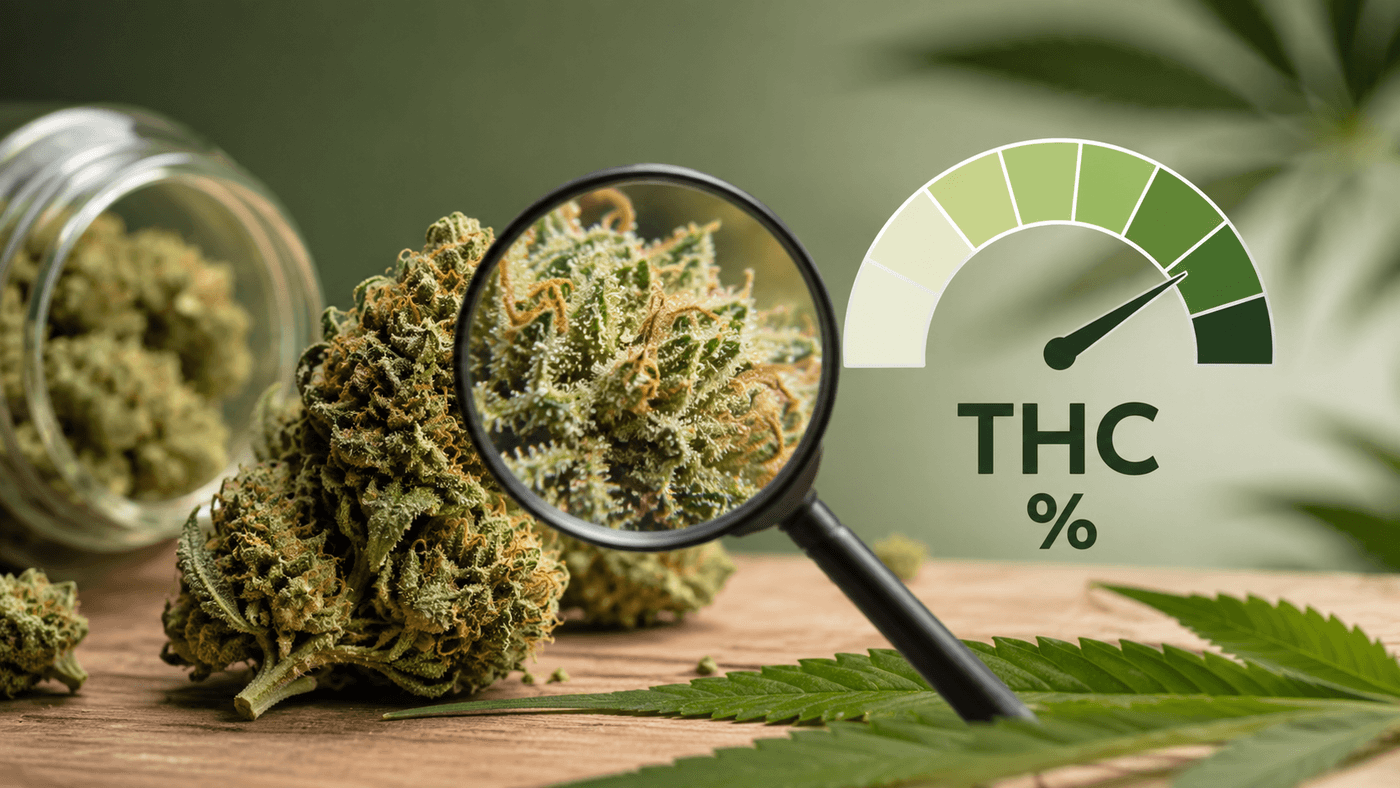
Understanding THC Percentages: What the Number on Your Label Actually Tells You
To some extent, we can all agree that most dispensary menus are all the same because almost every dispensary has those bold, bright THC percentages stamped next to every strain.
It's easy to assume the highest number wins, but cannabis doesn't work like that.
THC percentage is one piece of a much bigger picture, and leaning on it alone can lead you toward products that don't actually match what you're looking for.
Regardless of whether you're new to cannabis or you've been shopping strains for years, understanding what that percentage means, and what it doesn't, can completely change how you choose your next purchase.
This article breaks it down so you can shop with more confidence during your next dispensary visit.
What THC Percentage Means
THC percentage refers to the proportion of tetrahydrocannabinol, also known as THC, found in a given product by weight.
If a flower is labeled at 22% THC, that means roughly 22% of the dry weight of that flower is THC.
This number comes from lab testing, where a sample of the batch is analyzed, and the cannabinoid content is measured and reported on the certificate of analysis.
Also, you need to understand that the percentage is a measurement of potential potency, and not a guarantee of how a product will feel or perform.
THC content can vary from batch to batch of the same strain, depending on growing conditions, harvest timing, and even the specific plant phenotype used.
Two batches of the same strain name can test differently because cannabis is an agricultural product, and not a manufactured one with fixed specifications.
It's also helpful to know that THC percentage typically refers to total THC, which usually accounts for both THC and THCA.
Remember that THCA is the non-intoxicating precursor that converts to THC when heated through smoking, vaping, or cooking.
Raw flower is mostly THCA before it's activated by heat, so lab reports often show both figures separately, along with a calculated total.
Understanding this distinction helps explain why raw flower percentages can look different from what you'd expect based on how strong the product actually feels once consumed.
Furthermore, THC percentage gives you a rough indicator of strength, but it's not meant to be the whole story of what a strain will deliver.
Why Higher THC Doesn't Always Mean a Better Experience
It's a common assumption that more THC automatically means more enjoyment, but that's not how cannabis actually works in the body.
Everyone has a different tolerance level, and what feels balanced to a regular consumer can feel completely overwhelming to someone new to cannabis.
Chasing high percentages without considering your own tolerance is one of the most common ways people end up with an experience they didn't want.
There's also the entourage effect to consider, the idea that cannabinoids, terpenes, and other plant compounds work together to shape the overall experience.
A strain with a slightly lower THC percentage but a rich, well-rounded terpene profile can often feel more balanced, more flavorful, and more enjoyable than a high-THC strain with a thin terpene profile.
Terpenes influence everything from the aroma to whether a strain leans relaxing or energizing, and they play a real role in how the effects actually feel, and not just how strong they are.
Tolerance also builds over time. Someone who consumes cannabis regularly may need a higher percentage to feel the effects they're after, while an occasional consumer might get more from a moderate strain than expected.
This means that the best THC percentage is not a fixed number at all. It shifts based on your body, your experience level, and even your mood on a given day.
Instead of asking which product has the highest number, it's worth asking which product is likely to give you the experience you're actually looking for.
High THC percentages also don't tell you anything about how a strain smells, tastes, or how it will actually make you feel emotionally.
For instance, two 25% THC strains can produce completely different experiences depending on their genetics and terpene makeup.
That's why some of the most satisfying cannabis experiences come from strains in the moderate range, chosen because they suit the moment.
Other Factors That Affect Cannabis Quality
THC percentage is just one variable. However, there are a handful of other factors that also play a huge role.
These factors include:
Strain Genetics
The genetic lineage of a strain shapes its natural cannabinoid and terpene profile, its growth characteristics, and its typical effects.
Indica, sativa, and hybrid genetics each bring different tendencies to the table, and even strains within the same family can express themselves differently depending on the specific phenotype grown.
Genetics are mainly the blueprint, and they influence far more about the experience than the THC number alone ever could.
Method of Consumption
How you consume cannabis changes how quickly and how strongly THC affects you.
Smoking and vaping deliver effects almost immediately since THC enters the bloodstream through the lungs, while edibles take longer to kick in because THC has to be processed through the digestive system first, often converting into a more potent compound in the process.
This is part of why a 10mg edible can feel very different from a puff of 20% THC flower, even though both involve THC.
Freshness
Cannabis is a plant product, and like any plant product, it degrades over time.
Fresh flower tends to have a brighter aroma, better flavor, and a more vibrant terpene profile, all of which contribute to a fuller experience.
As the flower ages, terpenes evaporate and cannabinoids can degrade, which can dull both the flavor and the effects, regardless of the original THC percentage at the time of testing.
Storage
How a product is stored after purchase matters just as much as how it was stored before it reached the shelf.
Light, heat, and air exposure all accelerate the breakdown of cannabinoids and terpenes.
Keeping flower in a cool, dark, airtight container helps preserve potency and flavor for much longer than leaving it exposed on a counter or in a hot car.
How to Find the Right THC Percentage for You
Given that THC percentage affects everyone differently, the most useful approach is matching the range to your experience level and your goals.
Here's how to find your perfect fit.
Low THC (5% - 10%)
This is generally in the 5% to 10% range. It's a good starting point for those who are new to cannabis, sensitive to its effects, or simply looking for a mild, functional experience.
This range is well suited to daytime use, social settings where you still want to feel clear-headed, or moments when you want a gentle introduction without the risk of feeling overwhelmed.
Moderate THC (10% - 20%)
This is where a lot of consumers find their comfortable middle ground.
This range offers a noticeable, enjoyable effect without tipping into overly intense territory.
Besides, this is a versatile choice for relaxing after work, enhancing a creative activity, or easing into an evening without needing to plan the rest of your night around it.
Higher THC (20% and above)
This category is ideal for more experienced consumers who have built up tolerance and know how their body responds to stronger effects.
These strains can be a good fit for managing more significant discomfort or for consumers seeking a deeply immersive, long-lasting experience.
Even at this level, it's worth starting slow, especially with a new strain, since genetics and terpene content still shape how that higher percentage actually feels.
Finding Your Fit at Purple Lotus
Choosing the right cannabis product is not a matter of chasing the biggest number on the label.
All you need is to understand what actually shapes your experience and find what fits your body and your goals.
That's exactly what we do at Purple Lotus. As one of San Jose's most trusted dispensaries, we feature a carefully curated selection of low-, moderate-, and high-THC options.
Our knowledgeable budtenders take the time to understand what you're looking for and help match you with products that go beyond the percentage on the label.